

Do tell us about yourself, where you are from, and your work
I am from Kolkata. I started my career as a French teacher at Alliance Française. Thereafter, I taught French at Calcutta International School (CIS) and later became the Head of Modern Languages.
I have always been interested in the outdoors; the mountains are my happy place. This love for mountains ignited my interest in hiking, camping and mountaineering, leading me to complete the Basic and Advanced Mountaineering Course from Nehru Institute of Mountaineering (NIM), Uttarkashi. In parallel, I volunteered as a guide for Nature and Adventure camps for children and was an instructor for Basic Rock Climbing courses, organised by a Kolkata-based club in Purulia, West Bengal.
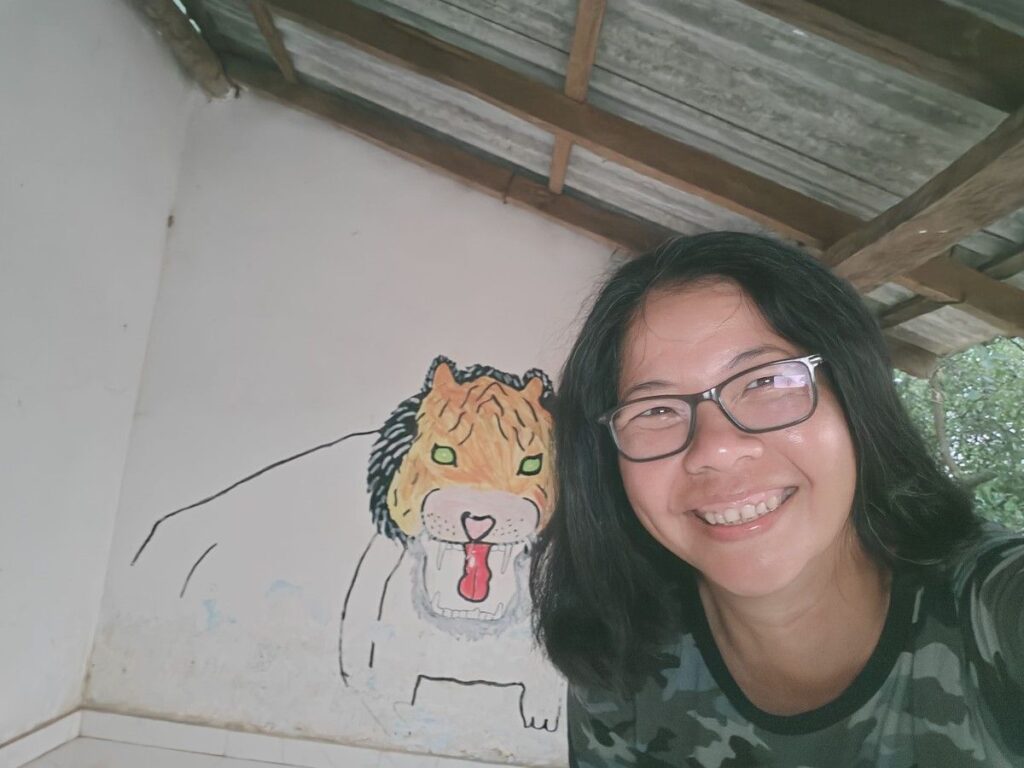
After CIS, I joined TCS as a French language expert. Today, I am a communications specialist in TCS CSR. Last year (2024), with All Women Nature Walks (AWNW) – Kolkata Chapter, I rediscovered Nature Education, though my focus is primarily on birds.
What excites you about the natural world?
Everything about nature fascinates me. Of course, when I started, it was birds. I found them just too cool for words. It helped that they were photogenic, and I enjoyed photographing them.
As I had the fortune of leading the All Women Nature Walks in Kolkata, I realised that every element of the natural world was equally compelling—from fungi and insects to butterflies, moths, snails, frogs, turtles, and snakes. My respect for trees has also grown manifold. I love being out in nature and observing whatever nature chooses to reveal to me on a given day. While I continue to have a soft spot for birds, today I approach nature in a more all-encompassing way.
While I don’t find trees as photogenic, I have, on multiple occasions, seen a tree in bloom (with flowers or fruit) attract so many birds and other life forms. This interdependence in nature is another thing that blows my mind away.

When and how did you get interested in bird/nature education?
My interest in nature education began as a volunteer guide for Adventure and Nature Camps. During these camps, ornithologists and botanists would take children for walks and show them birds and trees, making them realise their key role in nature.
Birds caught my imagination. They came in all shapes, sizes and colours, plus they were everywhere! The more I saw them, the more I wanted to learn about them. And the more knowledge I gathered about birds, the more eager I became to evangelise and advocate for them.
Thus began my love story with birdwatching and, by extension, nature education.
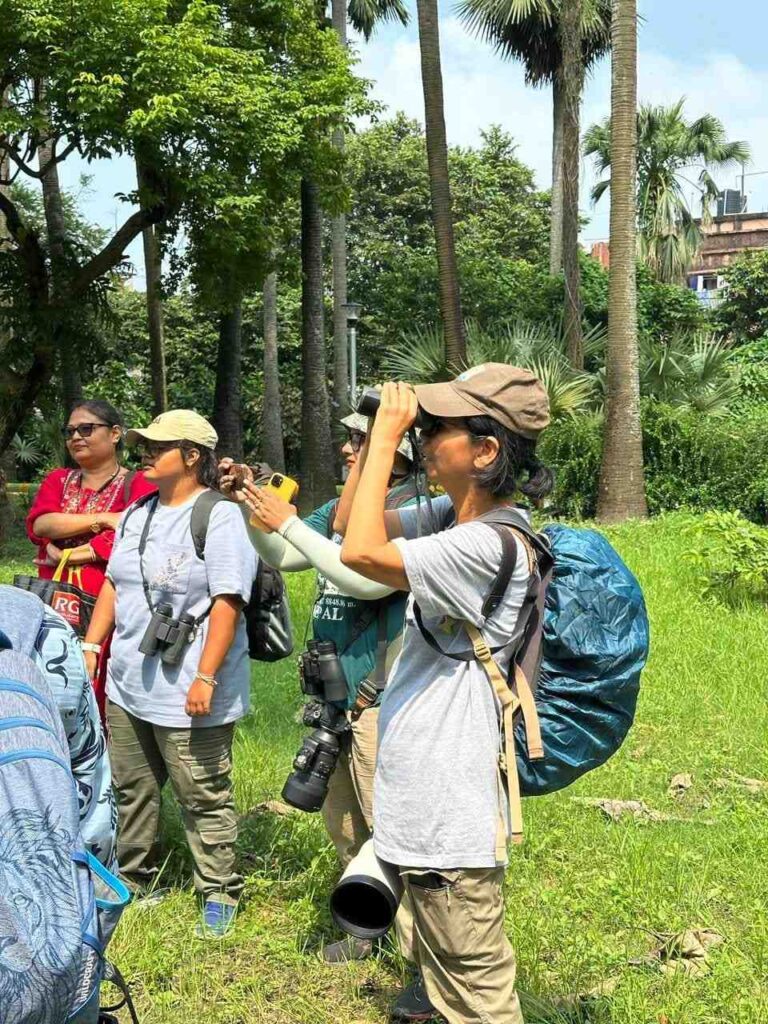
Photo credits: Preanka Roy
What do you hope to achieve through your education work?
I believe that teaching is the best form of learning. The joy of discovering something increases exponentially when shared. We are often so busy rushing through everyday life that we miss beautiful moments in nature—such as a bird carrying nesting material, courting its partner, or simply eating, bathing, or drinking.
To be able to pause, point out these moments to young minds and watch their eyes glow in wonder is a reward in itself. In my opinion, teaching the young to slow down, observe nature, be curious and ask questions are important life skills.
The beauty of it all is that there is still so much we don’t know about the natural world. The more we know, the more we will care. A quote that resonates profoundly with me states: “We do not inherit the Earth from our ancestors; we borrow it from our children.” Through nature education, I would like to create awareness about the role we play in the preservation of nature and help ensure that we return to our children a living, breathing, healthy Earth that they will be happy to live in.
Why do you believe it is important for children to learn about birds or connect with nature?
Children, particularly those living in urban India today, are often far removed from the natural world. As cities increasingly offer fewer open spaces for children to connect with nature, technology, such as the internet or mobile phone, has only resulted in children moving further away.
I remember this incident during a trek with my students from Calcutta International School. We were in a beautiful campsite in the Himalaya, and the sky was a riot of colours. The clouds were descending into the valley, and I just stood there mesmerised. A student came and stood beside me. The moment was ethereal. I got all emotional and turned to the student, asking, “Isn’t it beautiful?” The 14-year-old looked at me, puzzled, and remarked. “Seriously, teacher, couldn’t you have seen this on the internet?” The pristine moment was broken, and I addressed the remark directly.
So, yes, nature education is an absolute necessity today. Not only to help children become more connected with the real world, but also because nothing builds character better than nature education. Today’s children are tomorrow’s leaders. If they care about the planet, then they will strive to protect and heal it.
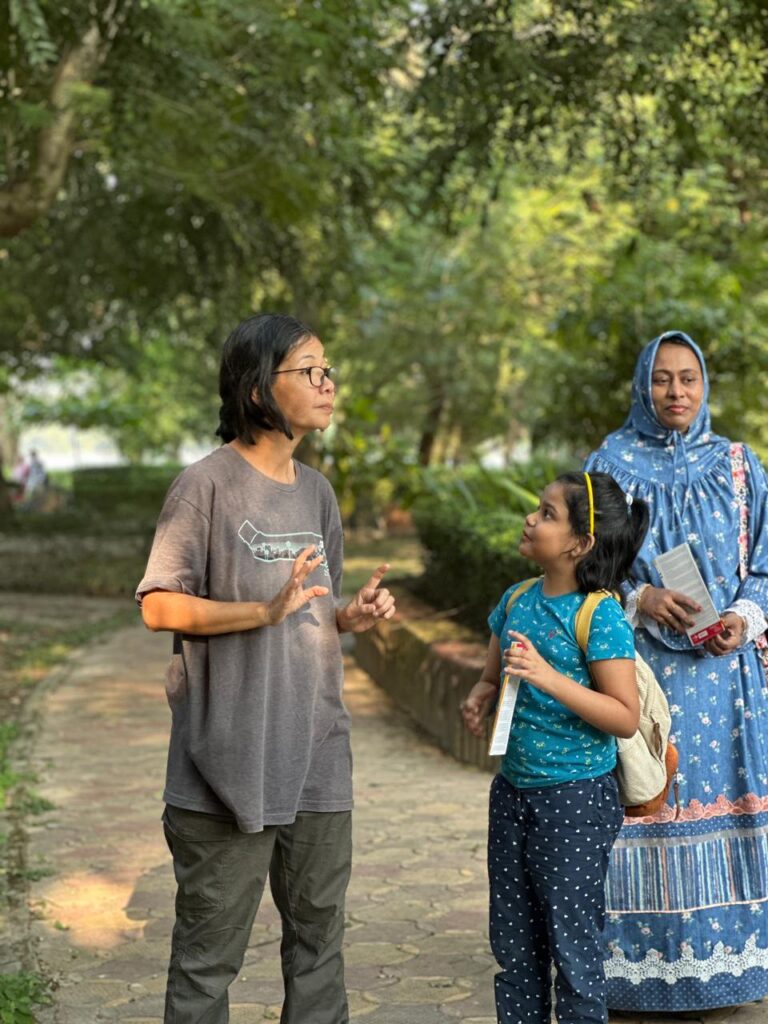
Photo credits: Preanka Roy
What tools or resources have helped you in teaching about birds? Can you describe an approach that has worked exceptionally well for you?
Since developing an interest in the natural world—particularly birds—my reading has focused on ornithology, ecology, biodiversity, and conservation. My primary digital tools include the apps eBird and Merlin, the Birds of the World website, and iNaturalist for other taxa.
As an educator, I frequently rely on the Early Bird pocket guides and Flashcards. I also reference books such as Conducting a Workshop for Young Birders, Let’s Talk About Trees, and Be a Neighbourhood Naturalist. Additionally, I reach out to members of the AWNW Kolkata group to conduct various activities, including nature journaling, zine making, etc., and enjoy creating activities to engage young birders. Collaborations such as the one with RoundGlass Sustain for content use and St Jude’s India’s pediatric centre for creating memories for children suffering from cancer—have also been very enriching.
My approach is simple: collaboration. When I need support, I consult our fabulous AWNW community. From the start, whether we needed an Instagram page or a logo, posters for the nature walks, developing activities for our walks, or setting up Nature Addas in the summer, it is our dependable community that has streamlined my work and propelled AWNW Kolkata to its current standing.
Have you encountered a significant challenge as a bird/nature educator, how did you overcome it?
So far, I have been fortunate. I have not experienced any challenges as a Nature Educator. Quite the opposite, I have received substantial support from everyone around me on my journey.
However, in the broader scope of nature education, I believe the main challenge is that children today are too far removed from nature, which, in my opinion, is detrimental to their well-being. The digital world is increasingly taking them behind screens, disconnecting them from reality. In my mind, the only way to overcome this is to take children outdoors, show them the wonders of nature, and spark their curiosity. We must mesmerise them and encourage them to explore more. The ultimate goal is that the next time a fourteen-year-old witnesses a glorious setting sun, he or she smiles with joy and graciously takes in the moment.
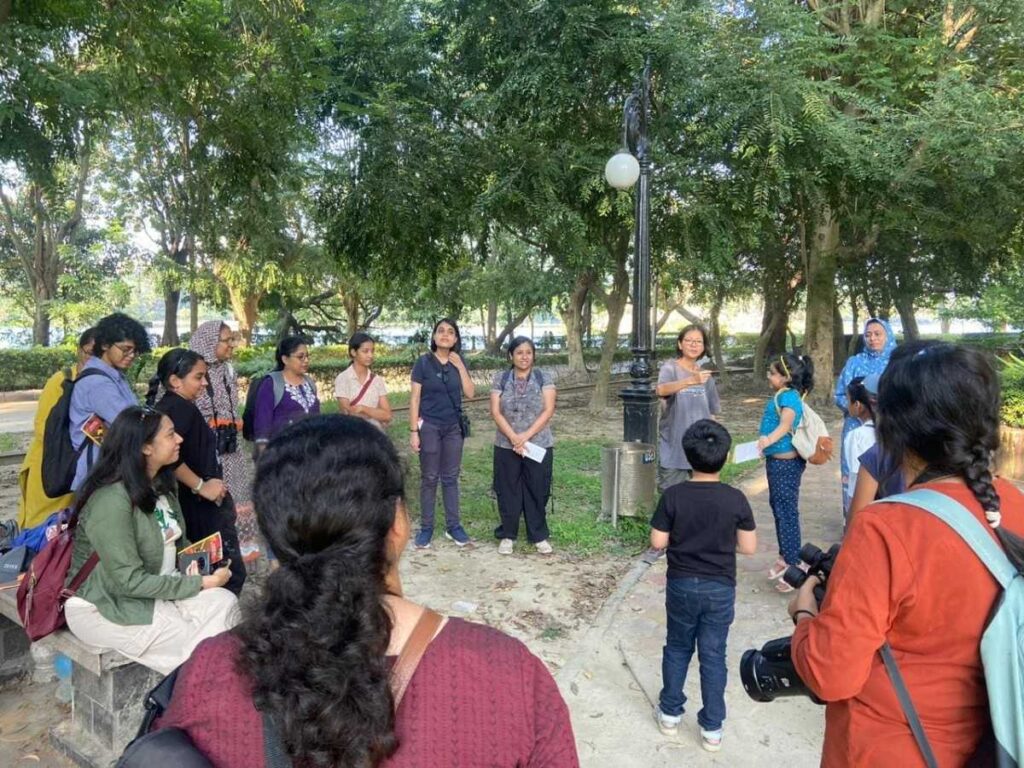
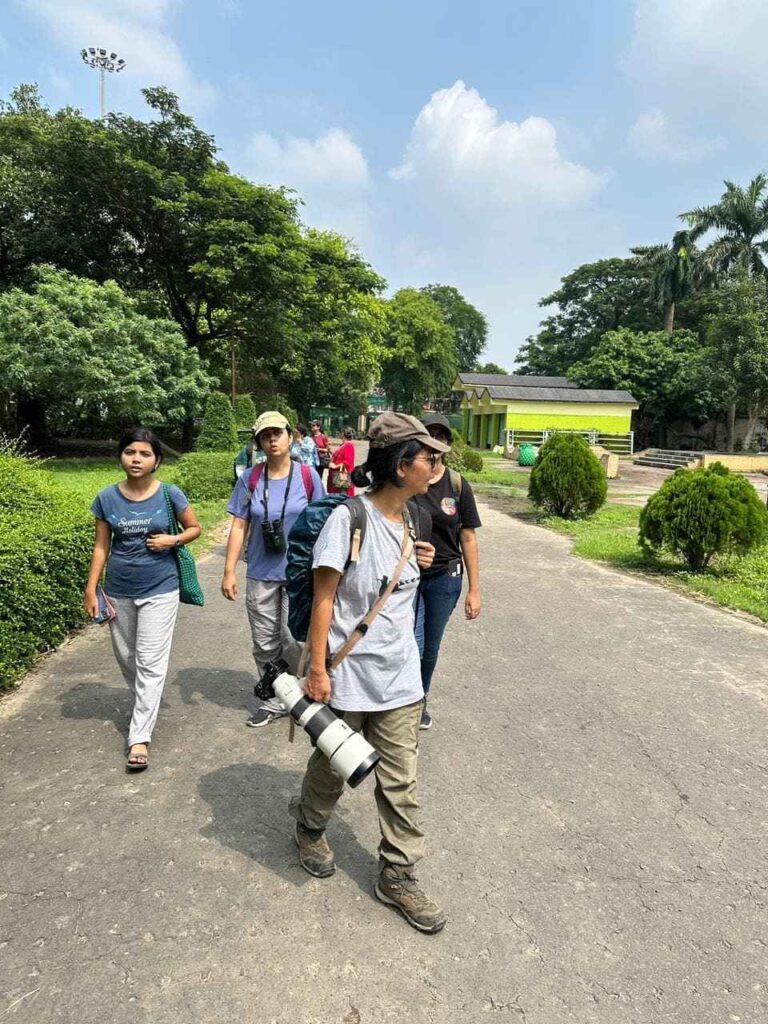
Photo credits: Ahana Bera
Do share any memorable moment or experience you have had in teaching kids about birds/nature. Can you recall any insightful instance that shaped your perspective?
When I was a volunteer for the Adventure and Nature Study camps with children, we took them to the field to observe birds. As there were no waterbodies nearby with water birds, we focused on forest birding. In those days, I did not have binoculars or a camera. The ornithologist was carrying both. The children were aged between 6-12 years and were first-year campers. Since it was their first time bird-watching and they did not have binoculars or a spotting scope, one child became very upset when he could not spot the birds.
That day, I learned several key lessons: when guiding first-time birdwatchers, we must prioritise waterbodies and select locations with larger birds to facilitate easy spotting for children. Coupling the activity with photos of the bird they had just seen in the field guide or on the phone helps recall. I also learnt that people need to be trained on how to use binoculars before they can really appreciate birdwatching with them. These are useful lessons I apply to this day.
I find working with children very stimulating. Every day that we work with them is the same yet different. The same applies to working in nature and advocating for it. As the adage states, you never step into the same river twice; ultimately, Nature is the best teacher. I have watched children stare in wonder, amazed by the Yellow Bittern’s ability to hide in plain sight, and clap spontaneously in joy upon seeing Yellow-footed Green Pigeons allo-preen. It was gratifying to see even the most fidgety kid sit still, mesmerised by the beauty of a jumping spider. Each such moment makes me realise the value of nature education.
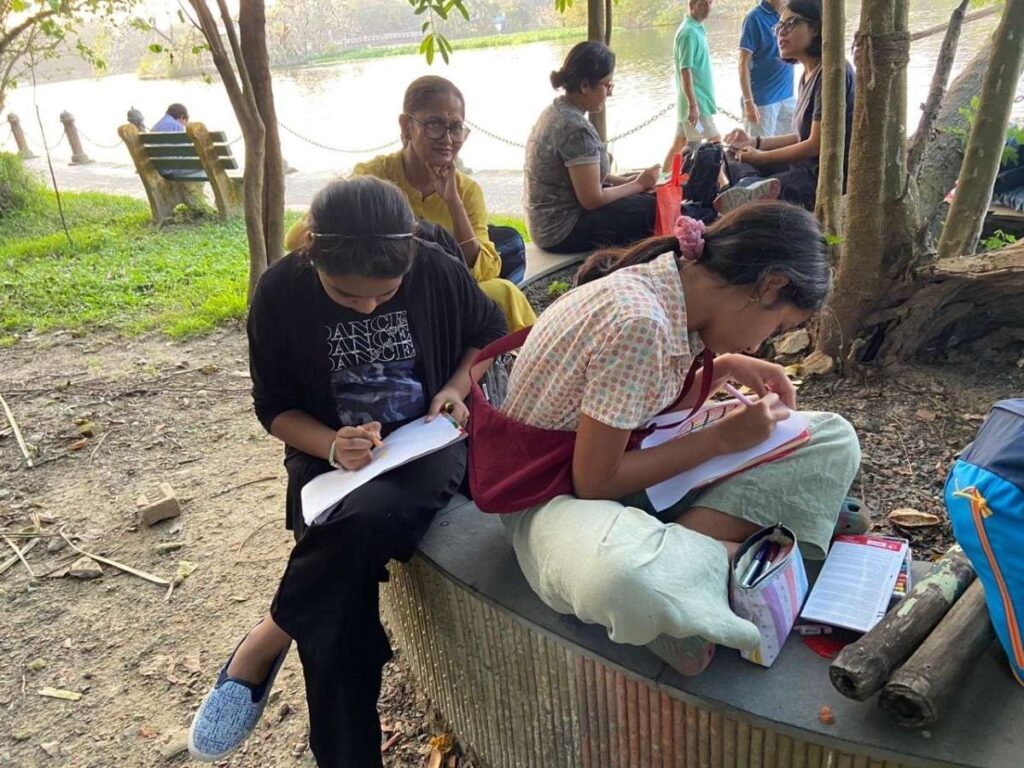
Have you noticed any changes in your learners after they received exposure to birds and nature-based learning? If yes, what are they? If not, why do you think that is?
The changes observed occurred over time rather than immediately. I noticed that concentration levels have increased, and children no longer complain about boredom as easily. Children exposed to outdoor education find ways to keep themselves occupied. They don’t need fancy toys and gadgets; instead, they find space to nurture their curiosity and develop empathy.
When a child finds a caterpillar on the road and uses sticks to rescue it and move it to safety, or when a young adult previously indifferent to nature begins to take an interest in birds—seeking ID or excitedly describing a bird or sharing a photo—I see small actions leading towards a better world. I was grinning from ear to ear when, recently, a young birder looked me in the eye and stated, ‘You have changed how I look around me now. I see birds everywhere!’
That said, the home plays a big role in shaping a child. Nature education or care for the natural world must be nurtured and encouraged at home, now more than ever.
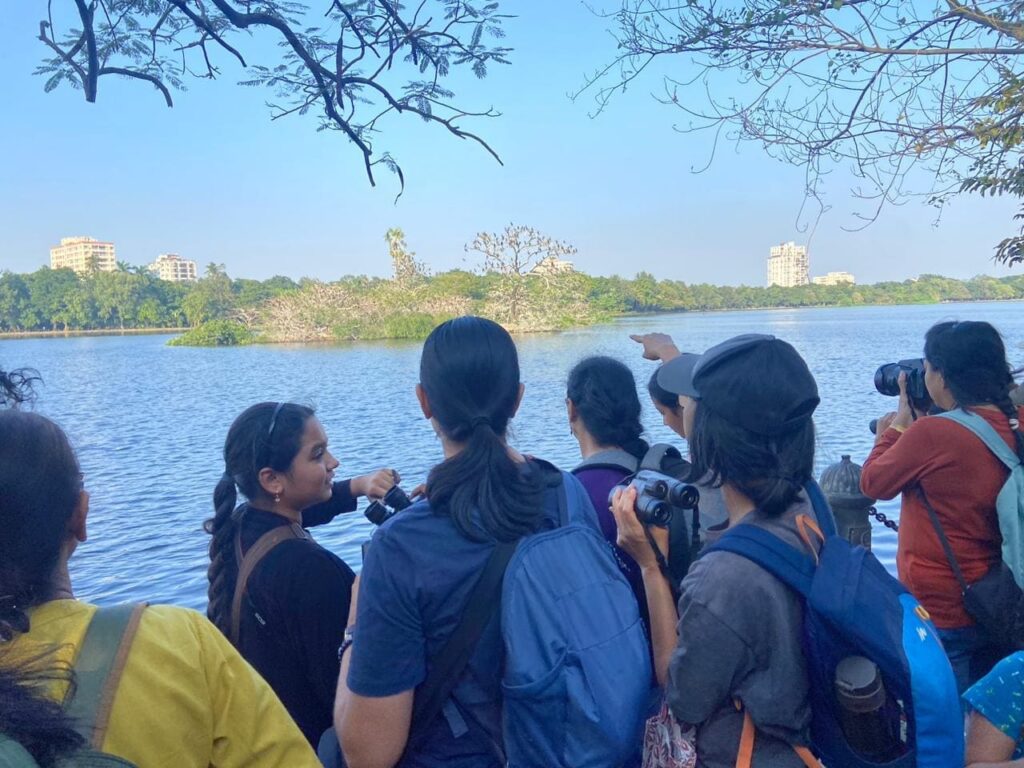
What message would you have for your fellow educators, or somebody starting out in their nature education journey?
I would say the more people include nature education in any form in their everyday lives, the better off we shall be. Nature education must begin at home. Here are my two cents: nature educators must upskill by gaining in-depth knowledge of their field (both theoretical knowledge and field experience) and start their journey.
I must insist that there is no substitute for fieldwork. Therefore, whenever possible, let us be out in nature, observe nature and keep the joy of wonder and discovery alive in us. Another point I would like to stress is the importance of reading from credible sources. As nature educators, we must not make Instagram, Facebook, YouTube, or WhatsApp our university, our only source of knowledge.
And finally, let us engage in discussions and interact with more knowledgeable, more experienced people and like a sponge, soak in as much as we can from these interactions.